The Whale on the Hill
Stories about mysterious games, kissing frogs, apples, chambers, and a walk to the impossible whale skeleton on the hill.
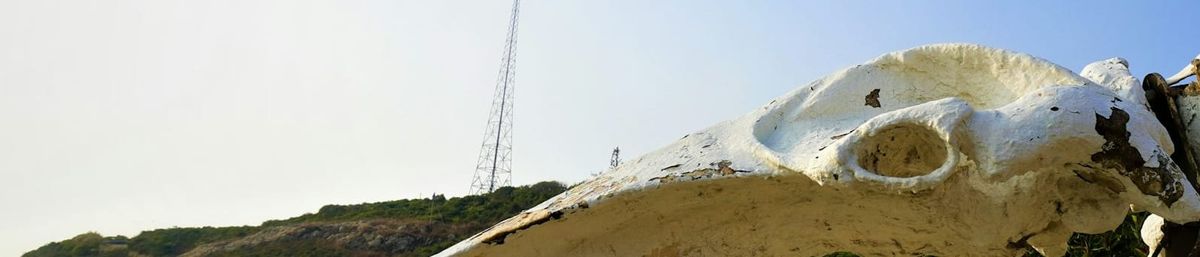
I sometimes think I would like to replace the freely-licenced photographs that illustrate most of these posts with my own drawings and photos. I have a few reasons for this. Convenience is not among them – but when the story is about a whale skeleton implausibly perched on a hilltop, perhaps drawing my own would be convenient. Thanks to Chengting Xie for this week's photo, which fits better than I could have reasonably expected.
This week’s daily stories
Monday
I was still wearing the daisy chain, and somehow I knew that when it broke I would too. But days in the sun had dried the stems until they were stiff and brittle. We did not have long left. Unless I lay down in the mud to be preserved, we would be separated soon – and the mud had dried too. As we picked our way along the crag I felt my foot twist and my body lurch. No sooner did I know I was falling than I felt myself caught: the daisy chain stretched between a jut of rock and my burned neck, seeming to grow stronger by its straining.
Tuesday
They spent the lesson looking up rude words in the dictionary. But something was wrong. A small agricultural holding. The part of the leg that extends from the knee to the ankle. Sticky or claggy dirt. Not one of them was rude at all. They had been tricked. They would go home and demand their parents teach them better, but they hadn’t the words to show how angry they were.
Wednesday
When she went round to Marnie’s house they played a game where you twisted sections of a crystal tower to make gems fall down into a treasure chest. There were rules, but Marnie wouldn’t let her see them. They always had to play just twisting and twisting until all the jewels fell, and then putting them back into the tower again. One day, when she was grown and made her own rules, she found a set, with all the gems accounted for. But the instructions were not with it. She could only twist and twist.
Thursday
The invitation said, ‘Dr Quick will meet you in his chambers’. It had all seemed very friendly, but Carys thought that nothing good had ever happened in a chamber. Chambers were for tests and torture and bullets. She wondered which she was in for. It didn’t matter. She was ready for them all.
Friday
One hundred days of kissing frogs for nothing but chapped lips and and upset stomach, and I feel fantastic. Why? Because the secret nobody wants to hear is: you were never going to find a prince in 100 days. This first stretch is all about building habits, refining techniques, and finding your pond base. Most people give up before they get there. If you’re still kissing frogs on day 101, you’re winning. Join my seminar this Tuesday to take your frog-kissing to the next level.
Saturday
When flowers began turning to fruit, I clipped off every setting apple I could find except for one. Into that one apple would go all of the sunshine of all of the days from now until the autumn. Into that one apple would go every drop of rain that fell. In August, I found it half-rotten on the ground, broken and wasted and beautiful.
Sunday
I was certain I had forgotten something. Sleeping bag, ground mat, water bottle, pants. I went through the kit list in my head, but by the time I reached the end of it, I was no longer sure about the things at the start. Waterproofs, wash kit, spare socks, sleeping bag. The pain of packing for someone else, for the excited little Beaver Scout you are responsible for: if it was for myself, I would say, it'll be fine, I'll make do. I would not check and re-check in the campsite car park. Even so, there had to be an end. I called myself content, and opened the back door of the empty car. I had left my excited little Beaver Scout on the sofa.
I have been reading...
- The Red-Haired Woman by Orhan Pamuk, a novel which appears simple in its style and the way it wears its themes on its sleeve, but which has a deeper richness you have to dig for.
- This House Isn't Haunted But We Are by Stephen Howard, part of Wild Hunt Books’ Northern Weird Project. I enjoyed the falteringly benevolent nature of the haunting in this – it's not a story of mystery, but of misunderstanding.
If you buy books linked to from Scattering, I may earn a commission from Bookshop.org, whose fees support independent bookshops.
The Whale on the Hill
On their last morning together, Kai and Emerald walked up to the whale bones on the hill. There was a light mist tumbling through the valley and pooling around the hill, so that it almost looked like an island; so that you could almost imagine how the whale might have drifted up there. Kai tucked his chin into his scarf and Emerald frowned at him. She didn’t like for people to hide their faces.
They never talked on their way up the hill. Today, they didn’t talk about the rumours of a government project, a taping off followed by the raising of a fence. By the time they reached the whale, they had exhausted the subject, although they both imagined the fence when they passed across the line where it would be.
Emerald imagined climbing it and Kai imagined cutting through it. Neither could imagine keeping outside it. The whale was theirs, was everyone’s: nobody who knew it could think otherwise. It wouldn’t be a protest to tear down that fence. There wouldn’t be anger in it. It would be like mending a bridge.